Accountable Law Enforcement

Constables are democratically-elected officials, answering directly to voters. Their community foundation fosters transparency, reducing misconduct common in centralized, bureaucratic law enforcement agencies. Independent from rigid hierarchies, political agendas, and special interests, constables avoid the bureaucratic shielding that can obscure accountability and lead to distrust of law enforcement. Constables are a direct, visible, and responsive link between the public and justice.

Rooted in Our Community

Elected at the township, borough, or ward level, constables are deeply connected to the local area, serving as familiar faces who understand the community’s unique needs. Constables strengthen the community through partnerships, collaboration, and active involvement. Their position as accessible, grassroots officers allows constables to bridge divides and strengthen social bonds in ways that larger, centralized law enforcement entities cannot. Constables serve as peacekeepers, a role that extends beyond enforcement to resolving conflicts within the community. They prevent disputes from escalating and help maintain social cohesion. As elected officials, constables embody a form of governance that reflects the people they serve. This democratic connection encourages residents to see them as allies rather than adversaries, fostering a collaborative spirit across cultural, economic, or generational lines. Constables uphold public safety in a way that aligns with local norms and values, rather than enforcing detached, centralized policies. This alignment unites residents around a common vision of their community’s well-being.

Ensuring Your Safety and Rights

Constables are committed to keeping the community safe from crime. They are also a bulwark in the system of checks and balances against corruption and overreach by state and federal governments. Constables, as locally elected officials, are not beholden to the political or financial incentives of a distant centralized authority, but remain accountable to the residents of their jurisdiction, giving citizens a direct voice in law enforcement and governance. By maintaining independence from centralized bureaucratic structures, constables can resist pressures or directives that might conflict with the interests of their community, thereby keeping centralized agendas from infiltrating local governance. By remaining outside of the control of centralized government, constables act as a check on systemic corruption within those institutions. With their roots in common law traditions, constables embody a legacy of protecting individual liberties and property rights against arbitrary government action, ensuring that power remains distributed and responsive to local needs rather than concentrated in elite hands.

Dedicated to Service

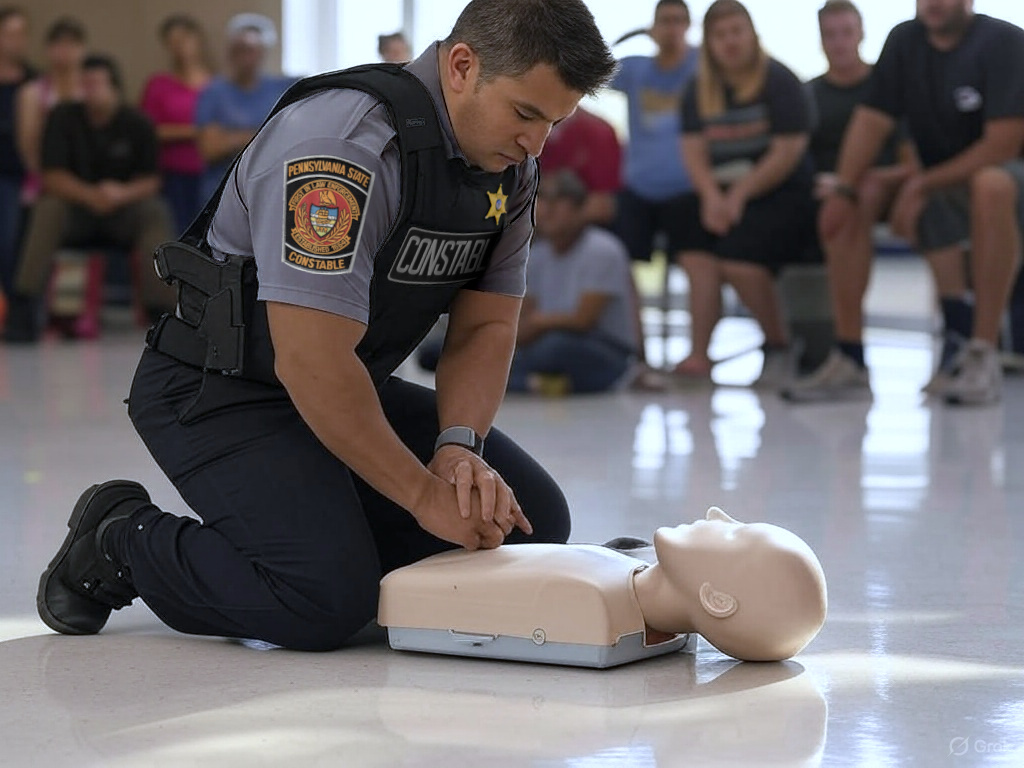
Constables' commitment to prioritizing the well-being of residents over mere enforcement is rooted in a tradition of acting as local guardians who address a wide range of civic needs. Unlike many modern law enforcement officers who focus primarily on crime suppression and prosecution, constables perform diverse tasks that directly support community life. Their duties include civil, judicial, and public safety functions, reflecting a holistic commitment to residents’ needs and the civic systems that underpin community life. By acting as officers of the court and aides to local government, they ensure these institutions function effectively. Beyond their formal duties, constables often engage in voluntary efforts — such as mentoring, charity events, or teaching safety classes. In today’s world, where policing can sometimes feel detached or militarized, constables stand out for their local, service-driven approach. Their independence from large bureaucracies allows them to focus on what locals need most rather than chasing centralized metrics like arrest numbers. This adaptability ensures they remain dedicated to serving people, not just systems.

About Constables

History

Constables are the oldest branch of law enforcement in the Commonwealth, established when James, Duke of York, seized control of the territory from the Dutch in 1664, even before King Charles II granted the colony to William Penn in 1681. This point of pride is highlighted by the Constables' motto, "First in Law Enforcement".

The Constable's powers and duties originate from pre-Revolutionary British common law in which Constables were in charge of the court of chivalry, a civil court with jurisdiction over matters of heraldry, served as justices of the peace, commanded garrisons and castles, and were responsible for arming the militia and suppressing riots and violent crimes. Modern Pennsylvania courts have recognized this ancient tradition in today's Constables' powers and duties: "In determining the authority of peace officers we must consider not only statutory powers but also any common law powers which preexisted and exceed those statutory powers". -- Taylor, 450 Pa.Super. at 589, 677 A.2d at 849.

With the establishment of paid state and municipal police forces during the 19th and 20th centuries, some powers of Constables, primarily over misdemeanor criminal matters and investigative functions, were given to police departments. Constables retained civil, judicial, and peace keeping powers.

Powers & Duties

  • warrantless arrest for felony crimes, offenses against any law for the protection of forests and timber land, any witnessed violation of any borough ordinance for which a fine or penalty is imposed, any unlawful act endangering personal security or property, and breaches of the peace committed in their presence, anywhere in the Commonwealth (Title 44 Pa.C.S. Chapter 71)
  • investigate criminal complaints as would a detective when directed by the court (Title 44 Pa.C.S. Chapter 71)
  • keep order at the election polls and ensure that no qualified voter is obstructed from voting -- constables are the only law enforcement officer permitted at the polls on Election Day (Title 44 Pa.C.S. Chapter 71)
  • serve complaints, summonses, and notices for the minor judiciary (Title 44 Pa.C.S. Chapter 71)
  • levy personal property for public sale to satisfy judgments (Title 44 Pa.C.S. Chapter 71)
  • execute orders of possession and ejectment (Title 44 Pa.C.S. Chapter 71)
  • execute warrants of arrest (Title 44 Pa.C.S. Chapter 71)
  • effectuate the payment of fines (Title 44 Pa.C.S. Chapter 71)
  • take custody and convey defendants and incarcerated prisoners (Title 44 Pa.C.S. Chapter 71)
  • provide for courthouse security (Title 44 Pa.C.S. Chapter 71)
  • direct traffic and no person shall willfully fail or refuse to comply with any lawful order or direction thereof (Title 75 Pa.C.S. Chapter 31)
  • impound and sell trespassing livestock (Title 44 Pa.C.S. Chapter 71)

Training

Constables are trained through the Pennsylvania Commission on Crime and Delinquency (PCCD) — the same agency that trains sheriffs and deputy sheriffs. Under Act 49, constables complete mandatory training before performing judicial duties:

  • 80 hours initial basic training
  • 40 hours initial firearms training
  • Annual continuing education: 8 hours in-person + 12 hours online
  • Annual firearms recertification: 8 hours

The curriculum covers: criminal and civil law and procedure, the PA unified court system, court security, prisoner transport and custody, mechanics of arrest, crisis intervention, management of aggressive behavior (MOAB), use of force, defensive tactics, expandable baton, chemical aerosol, professional communications and conduct, ethics, and firearms.

The PCCD firearms qualification course requires 60 rounds and 75% accuracy — comparable to MPOETC (municipal police) qualification at 50 rounds and 75% accuracy. Emergency vehicle operations are not part of constable training because constables are not highway patrol and have no highway patrol function. Their training matches their statutory mission.

Beyond the state mandate, the majority of constables invest substantially in additional private training throughout the year, including:

  • Active shooter response, CPR/AED, bleeding control, first aid, and wilderness first aid
  • Tactical emergency casualty care and life flight coordination
  • Community policing, patrol procedures, and domestic violence response
  • Emergency vehicle operations and patrol rifle certification
  • Drug awareness, K-9 handling, and mass casualty incident response
  • Search and seizure law, crowd control tactics, and report writing
  • FEMA Incident Command System (ICS) and National Incident Management System (NIMS)
  • Hazardous materials operations, naloxone administration, and rescue taskforce operations
  • Taser training, cybersecurity fundamentals, and leadership development

This voluntary training is funded entirely by constables themselves.

Equipment

Constables procure and maintain all of their own equipment with no government budget allocation or reimbursement. Typical equipment includes:

  • Badge and photo identification
  • Duty belt, holster, and restraints
  • Pepper spray and other less-lethal tools
  • Body armor (bulletproof vest)
  • Patrol firearm and ammunition (constables are authorized to carry firearms under Act 49)
  • Police scanner and two-way radio
  • Transport vehicle with prisoner cage (required by AOPC standards for visual and functional equivalency with police and sheriff vehicles)
  • Portable lighting and safety equipment

The total cost of equipping a constable from scratch — including a compliant transport vehicle — routinely exceeds $10,000, borne entirely by the constable.

Costs & Fees

Constables are required by statute (44 Pa.C.S. § 7142) to carry professional liability insurance — yet they are paid per service performed, not by salary, and receive no government benefits of any kind. They bear all training costs, equipment costs, vehicle costs, and insurance costs personally, and are taxed as self-employed individuals on all fee income.

For judicial duties — serving warrants, summonses, civil process, and court orders — fee schedules are set by the Pennsylvania General Assembly under Title 44 Pa.C.S. Chapter 71 and have not kept pace with inflation or the actual cost of service. For non-judicial services — peacekeeping, civil standby, event security, custody escorts, and other public safety work — constables negotiate rates directly with the requesting party, whether a government agency, business, or private individual.

Every constable service also carries a $5 training surcharge assessed under state law, the proceeds of which fund the Constables' Education and Training Board (CETB). This surcharge has been unchanged since 1994 — thirty years without adjustment — while training costs have risen substantially. The result is a training fund perpetually under financial pressure, even as opponents call for more training mandates.

Because constables are fee-paid independent officers — not employees of any government body — they receive no health insurance, no pension, no sick leave, and no other employment benefits. The practical result: constables are regulated like public officials, insured like professionals, and compensated like piece workers. The public receives essential law enforcement services; the constable absorbs the true cost.

Statistics

  • As of December 31, 2024, Pennsylvania had 1,265 elected constables statewide, of whom 866 were actively certified by the Constables' Education and Training Board (CETB). They serve all 67 counties across thousands of townships, boroughs, and wards. (Source: CETB 2024 Annual Report)
  • In 2024, constables performed an estimated over 300,000 judicial services statewide — warrants, summonses, civil process, prisoner transport, and court orders — based on CETB training surcharge fee collections. (Source: CETB 2024 Annual Report)
  • Constables are the only law enforcement officers legally permitted inside polling places on Election Day under Pennsylvania law — a role held since the founding of the Commonwealth.
  • When the Pennsylvania State Police were organized in 1905, the legislature explicitly granted them "all the powers and prerogatives conferred by law upon members of the police force of the first class, and upon constables of the Commonwealth" — the constable system was the foundational authority from which all other Pennsylvania law enforcement derives.
  • Without constables, rural communities throughout Pennsylvania would lose their only practical local law enforcement presence.

Issues Facing Constables

Lawfare

Lawfare means using courts and government agencies as weapons — not to serve justice, but to destroy political opponents. Pennsylvania constables have been subjected to a coordinated campaign by state law enforcement bureaucracies to strip their authority and eventually eliminate the office altogether.

Consider Constable Steven Ahmad Wiggs. He was in a marked police cruiser, in uniform, performing an official law enforcement duty. He had emergency lights on. State police prosecuted him for it — not because he did anything wrong, but because state agencies had decided constables should not be allowed to operate the way the legislature authorized them to operate.

This is not isolated. Courts have been used to charge constables for performing duties explicitly authorized by state law. State agencies have issued policy documents that constable advocates argue erase powers the legislature granted. The strategy is simple: if you can strip constables of operational authority, you can eventually argue the office is redundant.

The Pennsylvania Superior Court has affirmed that "in determining the authority of peace officers we must consider not only statutory powers but also any common law powers which preexisted and exceed those statutory powers." (Commonwealth v. Taylor, 450 Pa.Super. 583 (1996).) Executive agencies cannot, through rulemaking or policy interpretation, diminish powers granted by statute or common law to independently elected officials. (In Re Act 147 of 1990, 528 Pa. 460 (1991).) The lawfare campaign against constables is an attempt to accomplish through litigation and bureaucracy what opponents cannot accomplish through the legislature.

Taxes

Pennsylvania constables pay a hidden tax that most law enforcement officers never face. Because they are paid per service — not by salary — the IRS treats their income as self-employment income. That means an additional 15.3% self-employment tax, on top of regular income taxes, on income they are already spending on training, equipment, vehicles, and liability insurance.

Constables have encountered inconsistent guidance from Pennsylvania tax authorities on how to classify fee income across tax years, leaving many officers — particularly those new to the office — unprepared for the full tax burden they face.

Some constable advocates have argued that fee income should be treated more consistently with other elected-official compensation — a reform that would better reflect constables' constitutional standing and the essential public service they provide.

Powers

Pennsylvania constables have more legal authority than most people realize — and that authority is exactly what makes them a target. State police organizations and government agencies have spent years in court arguing that constables, despite explicit statutory grants of power from the legislature, are not "real" law enforcement. The strategy is straightforward: if you can strip constables of operational authority, you can eventually argue the office is redundant.

When the Pennsylvania State Police were created in 1905, the legislature granted them authority derived directly from constable powers. Under 75 Pa.C.S. § 3102, no person may "willfully fail or refuse to comply with any lawful order or direction of... any uniformed police officer, sheriff or constable" — placing constables on equal statutory footing with police for traffic control. 44 Pa.C.S. Chapter 71 grants constables comprehensive arrest, investigative, civil process, courthouse security, prisoner transport, and enforcement authority.

Despite this legislative framework, centralized interests have mounted continuous attempts to narrow these powers:

  • Restricting warrantless arrest authority to the constable's home ward or township
  • Eliminating court-directed investigative authority
  • Stripping constables from courthouse security assignments in favor of centrally controlled employees
  • Arguing in court that constables lack "police officer" status for operational purposes, despite clear statutory equivalency

Training

The training requirements constables must satisfy are rigorous — and paid entirely out of pocket. Proposed "reforms" from law enforcement unions frequently use training as a pretext to eliminate the constable office rather than to improve public safety.

Constables are not highway patrol and never have been. Demanding police-academy-level training mandates of hundreds of additional hours in motor vehicle enforcement and emergency vehicle operations — at a cost of thousands of dollars per officer — would make the office economically unviable for working people without serving any public safety purpose. Applying a highway patrol training standard to a different function is not a reform; it is a pretext.

The legislature grants statutory authority; if it intends to condition that authority on specific training, it enacts that requirement explicitly. Until it does, courts and administrative agencies may not infer such a restriction or use its absence to nullify the authority constables lawfully hold. Many constables voluntarily pursue extensive additional training at personal expense, far exceeding any state mandate — because they take their role seriously, not because the law requires it.

Election Integrity

Pennsylvania law designates constables as the only law enforcement officers permitted inside polling places on Election Day. This deliberate design ensures election security rests with directly elected officers accountable to local voters — not officials appointed by the executive or controlled by party-appointed officials.

Threats to this role include:

  • Legislative proposals to remove the constable's election-day presence in favor of "election security officers" appointed by the Secretary of State
  • Attempts to restrict constables inside polling places to passive observation, removing their authority to maintain order and protect voters
  • Elimination of the constable's role in jurisdictions with insufficient active constables, rather than supporting constable recruitment and retention

Constables at the polls protect voters in both directions: they prevent illegal interference with the voting process, and they ensure no qualified voter is wrongfully turned away. Their independence from state political structures makes them uniquely suited to this role — accountable only to local voters, not to any party, agency, or appointed official.

Take Action

Pennsylvania constables need your voice. It takes two minutes.

Contact your state representative and senator. Tell them you support locally elected constables and oppose any legislation that would diminish their authority, restrict their training pathways, or eliminate the office. Use the links below to find your representatives — just enter your address.

Contact / Social Media

Share this page:

Paid For By Private Donations