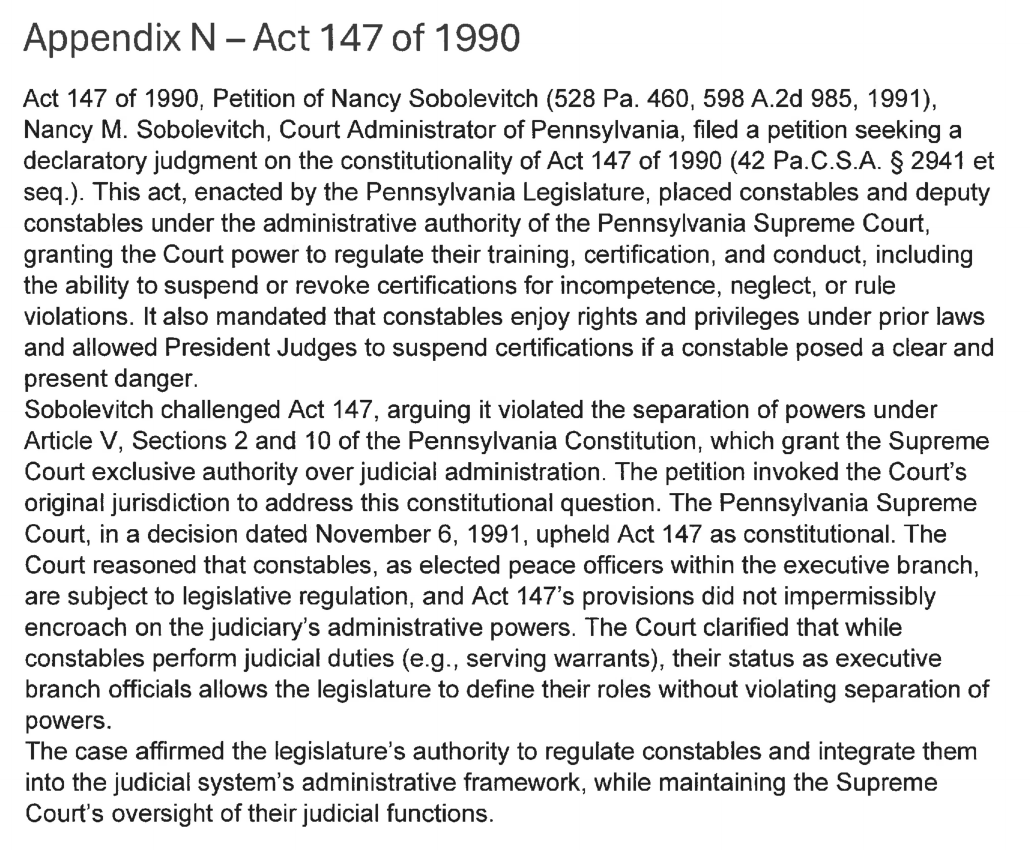
| Appendix N (p. 19): In re Act 147 of 1990 “upheld Act 147 as constitutional” and “affirmed the legislature’s authority to … integrate [constables] into the judicial system’s administrative framework.” | In re Act 147 of 1990, 528 Pa. 460, 598 A.2d 985 (Pa. 1991) | Inverted The Supreme Court declared Act 147 “invalid and unenforceable.” It held that a constable is a peace officer who “belongs analytically to the executive branch,” and that placing constables under judicial supervision violated the separation of powers. The document states the opposite of the holding. |
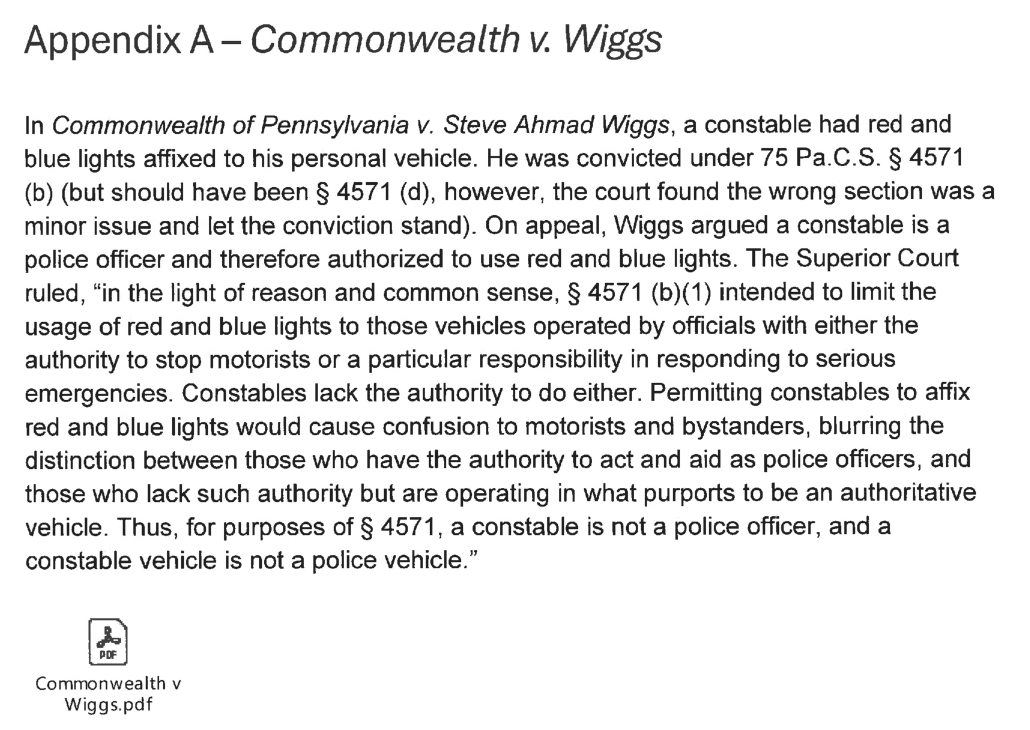
| Appendix A (p. 6): Commonwealth v. Wiggs is an emergency-lights case in which the Superior Court held that “a constable is not a police officer, and a constable vehicle is not a police vehicle” for purposes of 75 Pa.C.S. § 4571. | Commonwealth v. Wiggs, 2026 PA Super 126 (en banc); pending further review in the Supreme Court of Pennsylvania | Not in the test This describes the lights case, which we say was wrongly decided and are fighting. Whatever its outcome, it is a Title 75 Vehicle Code holding. The criminal justice agency test in 18 Pa.C.S. § 9102 has no “police officer” element; prosecutors and probation agencies meet it without ever being “police.” A ruling on vehicle lights says nothing about whether the office performs the administration of criminal justice. The appendix also quotes, without citation, the February 6, 2025 panel opinion, including its sentence that constable lights “would cause confusion to motorists and bystanders”; reargument en banc was granted, and the operative opinion of June 17, 2026 reaches the same result without that sentence. The document’s only judicial support for a confusion rationale is a sentence the controlling opinion does not contain. |
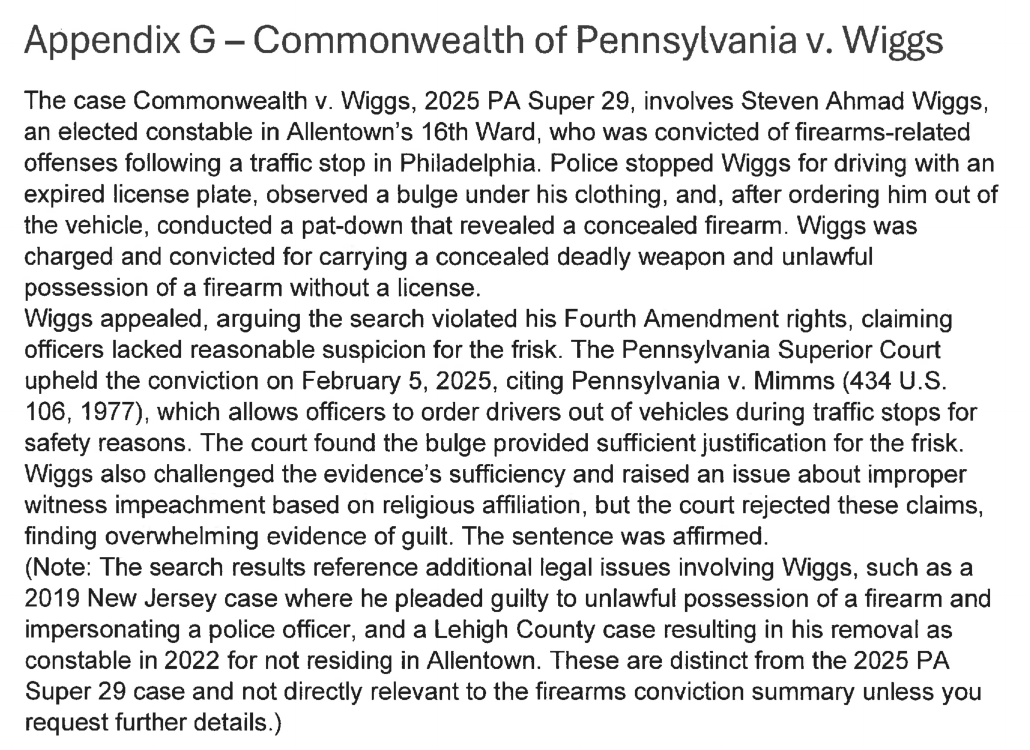
| Appendix G (p. 12): “Commonwealth v. Wiggs, 2025 PA Super 29” is a Philadelphia firearms conviction affirmed on February 5, 2025, and the appendix closes: “These are distinct from the 2025 PA Super 29 case and not directly relevant … unless you request further details.” | The site’s own case record; Superior Court dockets | False 2025 PA Super 29 is the Perry County emergency-lights panel decision, the same case Appendix A describes six pages earlier. Every Philadelphia charge against Constable Wiggs was dismissed, quashed, or ended in a not-guilty verdict. The document cites the lights case for a firearms conviction that does not exist: 2025 PA Super 29 is the Perry County summary appeal at No. 641 MDA 2023, filed February 6, 2025, affirming a $500 fine for red and blue lights on a constable’s personal vehicle, with no Philadelphia stop, no firearm, and no conviction beyond the summary fine. The narrative’s stray details match other appendices in the same packet, and the closing sentence is an automated research tool talking to the person who prompted it, left standing in the text. |
| p. 5: Constables “do not investigate crimes or act as primary responders.” | 44 Pa.C.S. § 7157(b); 18 Pa.C.S. § 9102; 28 C.F.R. § 20.3(g) | False Section 7157(b) authorizes a court to direct a constable “to investigate a complaint of a violation of law” and report back. That is statutory investigative authority. And no criminal justice agency definition contains a “primary responder” element; a public defender’s office responds to nothing and is designated. In much of rural Pennsylvania the constable is the officer residents call directly and the first one on scene. Peacekeeping and civil-standby requests put constables on site where crimes in progress are handled on the spot. On every eviction, levy, and warrant the constable is first through the door and often the only officer present. |
| p. 5: “There is no primary ‘constable agency’ to assign such an identifier to.” | 44 Pa.C.S. § 7122; §§ 7114, 7141, 7142, 7172; 2 Pa.C.S. § 101 | Misleading Chapter 71 never uses the word “agency” for anyone. It creates an office, headed by an elected constable with the sole statutory power to appoint deputies, subject to court approval, bonded, insured, certified, and removable by the court of common pleas. The Administrative Agency Law makes “any officer” of a political subdivision a “government agency.” The State Police already sign user agreements with one-officer borough departments. The unit exists; the State Police decline to see it. |
| p. 3: Constables are “not considered a traditional law enforcement agency with centralized oversight or direct affiliation with a state or municipal governing body.” | 18 Pa.C.S. § 9102; the Attorney General’s lists | Not in the test None of those words appears in the statute, the federal rule, or the State Police’s own regulation. Private campus and hospital police have no state or municipal governing body, and the Attorney General has designated more than twenty university and hospital forces, most of them private. |
| p. 3: Constables “operate independently, often as contractors, primarily serving judicial functions.” | 18 Pa.C.S. § 9102 (“allocates a substantial portion of its annual budget”); 28 C.F.R. § 20.3(g) | Not in the testMunicipal departments contract their services every weekend: neighboring municipalities, stadium details, work zones. The constable office’s own municipal engagements are of the same kind: a township or borough that engages the office to enforce its ordinances is buying law-enforcement work. “Judicial functions” is wrong as well. Peacekeeping and civil standby are common-law executive peace-officer functions performed predominantly on public request, with a court-ordered subset such as protection-from-abuse service under 23 Pa.C.S. § 6106(f), and Act 147 places the office in the executive branch. Both definitions ask what share of an entity’s budget goes to criminal justice work, not where the money comes from. Campus police run on tuition and SEPTA police on fares, and both are designated. A constable office funded by warrant, transport, and criminal-process fees allocates nearly all of its budget to the administration of criminal justice, which is exactly what the test asks. |
| p. 3: Constable training under Act 49 “is therefore not equivalent to the standardized training required for traditional law enforcement agencies.” | 44 Pa.C.S. Ch. 71, Subch. E; 18 Pa.C.S. § 9102; 28 C.F.R. § 20.3 | Misleading Act 49 certification is the statutory floor, not a description of what constables actually complete, and no criminal justice agency definition contains a training-equivalence element. The Attorney General has designated entities whose staff have no law enforcement training at all. CLEAN operator certification is a State Police requirement applied to every agency’s users alike; constable users will complete it like everyone else. |
| p. 3: Constables “do not meet the criteria for an ORI, which requires clear agency accountability.” | The document itself | Misleading The document never states the criteria. Not on this page, not anywhere in its 21 pages. An agency that has issued ORIs for three decades works from written criteria; those criteria, not this narrative, are its real position. We are demanding them under the Right-to-Know Law. |
| p. 4: Full-access ORIs require meeting 18 Pa.C.S. § 9102 and 28 C.F.R. Part 20. | 18 Pa.C.S. § 9102; 28 C.F.R. § 20.3 | Accurate, and it helps us That is the whole test, and it is functional. The document then quotes the Attorney General designation clause on page 5 without noticing that it supplies the very path the document says does not exist. |
| p. 4: “Non-governmental railroad or campus police departments” qualify for full access. | The Attorney General’s lists | Accurate, and it helps us Private-parent entities hold full-access ORIs today. The lists show how they got there: Attorney General designation under § 9102. The route is open. |
| p. 4: Four ORI types, the fourth a State Assigned Judiciary ORI “to accommodate the agency’s needs for issuing citations,” with “no access granted to the CLEAN or NCIC files”; Appendices F and O then object that constables cannot file charging documents or issue citations. | The document itself (p. 4; Appendices F and O) | Introduced, then abandoned The document describes four ORI types, including a citation-purposes identifier that carries no database access, and then argues from a charging-document objection that applies only to that type — circularly, since the judiciary ORI is itself the instrument of electronic citation filing: the office is denied the identifier because, lacking the identifier, it must file by private criminal complaint. The incapacity the denial cites is the incapacity the denial creates. Neither appendix concerns CLEAN or NCIC access at all, and the citation-power premise is wrong besides: the campaign maintains constables hold that power under Rule 103 and 44 Pa.C.S. § 7158 today. This objection simply cannot bear on the file-set access sought. Appendix O, the packet’s only claim that a statute withholds citation power, prints one sentence about an October 8, 2020 AOPC email with no quoted text and no legal reasoning — and six days later, on October 14, 2020, the Secretary of Agriculture wrote that constables are “police officers” empowered “to file violations for criminal prosecution” under the Dog Law (3 P.S. § 459-901(a)). The position could not survive its own week. The officer-safety files the office needs are the limited-access set described on the same page, which that objection never touches. The document never asks whether its own fourth tier answers its own charging-document rationale. |
| Appendix J (p. 15): In Commonwealth v. Allen the constables acted within their common-law powers to detain for a breach of the peace; Roose distinguished. | Commonwealth v. Allen, 206 A.3d 1123 (Pa. Super. 2019) | Concedes our point Accurate, and it concedes the point: constables hold a peace-officer power to stop and detain at a vehicle for a breach of the peace, an in-presence felony, or an imminent danger. That power is administration of criminal justice. The Supreme Court’s July 10, 2020 order granted review limited to the continued-detention question and denied it on everything else, and on March 25, 2021 the Court dismissed that appeal as improvidently granted. Allen is final, and the appendix reports as open a question the Supreme Court closed; it also dates the incident to 2018 when the findings place it on April 24, 2017. |
| Appendix K (p. 16): Commonwealth v. Taylor: a constable’s warrantless felony arrest during an eviction was lawful under the “citizen’s arrest doctrine.” | Commonwealth v. Taylor, 677 A.2d 846 (Pa. Super. 1996), as quoted in Allen | Misleading Right result, wrong label. Taylor held that “constables possessed the power at common law to make warrantless arrests for felonies and breaches of the peace.” That is a peace-officer power, not a citizen’s. The Supreme Court said the same thing in Act 147: the constable is “a known officer charged with the conservation of the peace, and whose business it is to arrest those who have violated it.” |
| Appendix L (p. 17): Commonwealth v. Roose: constables lack authority to make traffic stops; Motor Vehicle Code violations are “not inherently ‘breaches of the peace’ unless they involve immediate public danger.” | Commonwealth v. Roose, 710 A.2d 1129 (Pa. 1998) | Concedes our point Accurate as to the holding, and the appendix states the exception itself. A constable with NCIC access is not asking to write speeding tickets; the wanted-person, protection-order, and stolen-vehicle files are for the warrant, transport, and standby missions the office actually performs. One overclaim: the appendix says Roose was “discharged”; the opinion says only “Affirmed.” |
| Appendix M (p. 18): Commonwealth v. Rodriguez, a window-tint case: “The Superior Court affirmed on May 15, 2012,” ruling that a constable’s vehicle is not a “government vehicle.” | Commonwealth v. Rodriguez, 81 A.3d 103 (Pa. Super. 2013) | Misstated May 15, 2012 is the date of the judgment of sentence; the Superior Court decided the appeal on November 22, 2013. And the court expressly declined the “government vehicle” question the appendix says it decided, calling that analysis “unnecessary in the case sub judice,” and resolved the case on the constable’s non-employee status. A vehicle-equipment case in any event, with no bearing on criminal justice agency status. |

 Share on Facebook
 Share on X
 Share by Email